
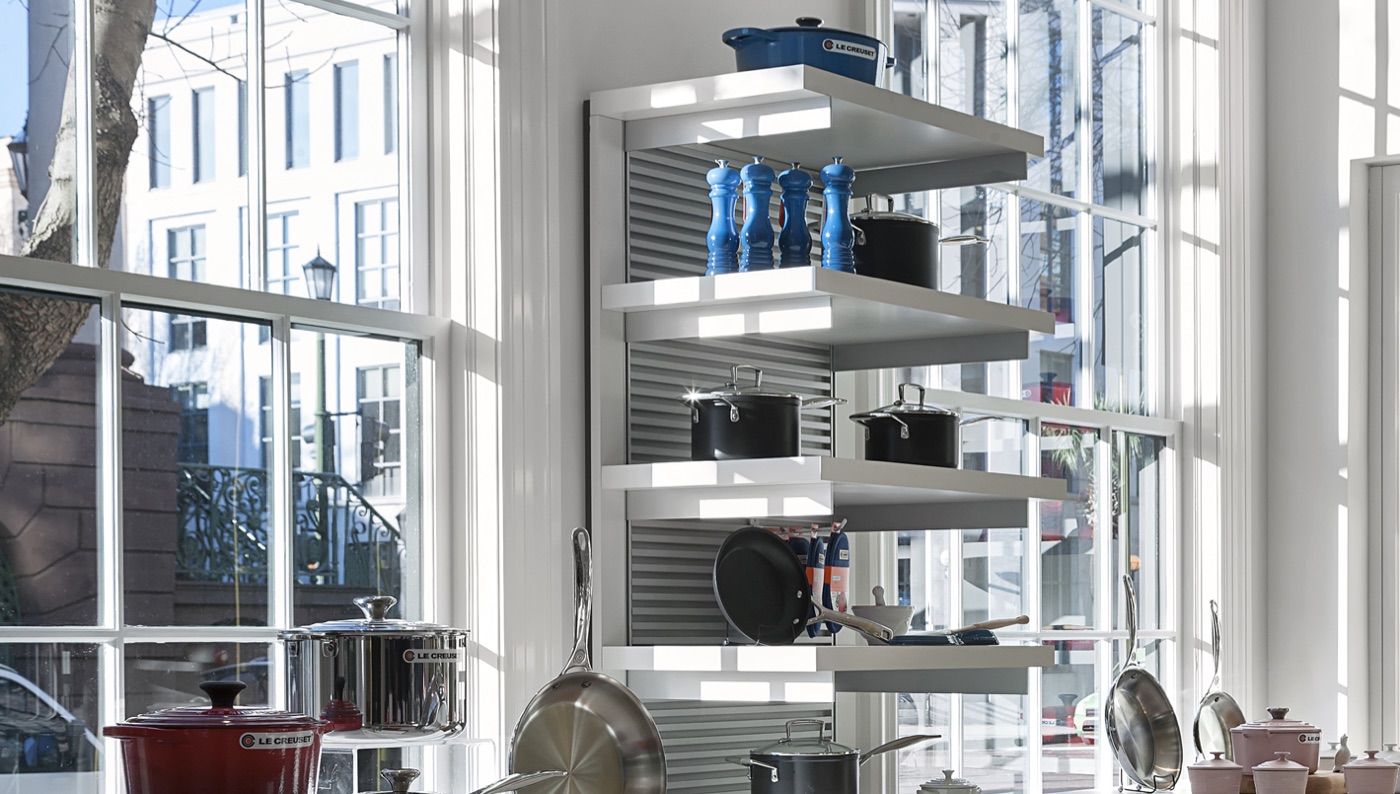
The engineers are down the hall from the laser. That changes what a design review costs.
Megawall has in-house design and engineering resources, and they sit inside the same 45,000 sq ft building as the machines that will make the part. Concept, prototype, sample, production — without a drawing ever crossing a company boundary.
Capability
We designed and patented our own products. That is the portfolio.
In the late 1980s Megawall engineered the first wall display system with a concealed fastener, and patented it. Shortly after, the patented 1″ on center aluminum display. Both are still in production, still selling, and still made in this building. That is the most honest evidence we can offer that the engineering here produces manufacturable products rather than drawings.
For contract customers the practical benefit is speed of iteration. When engineering, cutting, forming, welding and finishing are all in one building, a design change is a conversation and a new nest — not a re-quote from three subcontractors and a two-week gap.
Arrive with a CAD file, a sketch, or a part you need reproduced or improved. All three are normal starting points.
Engineering support
Concept to production- Starting points
- Finished CAD file
- Dimensioned drawing
- Sketch or concept
- Existing physical part
- Deliverables
- Custom frame and fixture designs
- Custom colour matching
- Custom lengths and widths
- Retail display engineering consultation
- Sample production
- Prototyping
- Single-part prototyping in the same plant as production
- Track record
- Two patented display systems, including US 7,571,571
- Production route
- Laser, brake, weld, machine, finish, assemble, ship — all on site
- Scale
- Prototype, sample, small batch, production, multi-location rollout
What to send us
The four things that let us quote properly.
The problem, not just the part
Tell us what the part has to do. We frequently find a cheaper geometry once we understand the load, the assembly and the environment.
What is fixed and what is not
Interfaces and mounting points are usually non-negotiable; the rest often is. Knowing which is which is where the cost comes out.
Volume expectations
A part designed for a run of fifty is not the part you want at fifty thousand. Say where you expect to land, even roughly.
Finish and environment
Powder coat, clear coat, indoor retail, humid or refrigerated — all of it changes material and detail decisions upstream.
Good to know
Common questions about design & engineering
Other capabilities
Ready to start
Tell us the material, the thickness and the quantity.
That is usually enough for a feasibility answer on the same call. Drawings help; a photo of the existing part works too.