
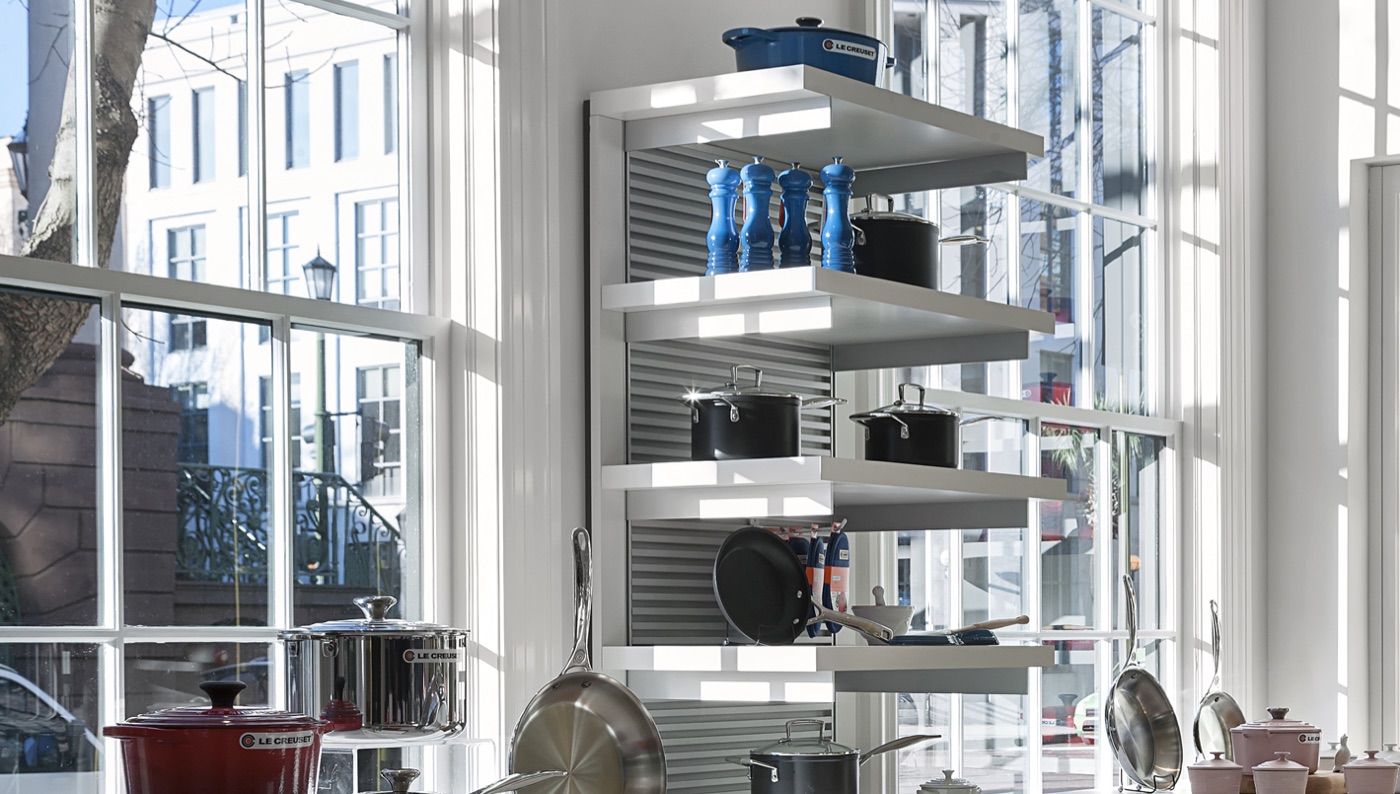
When the fixture you need does not exist yet.
Megawall designed and patented its own display systems, then built the plant to manufacture them. That same engineering and the same machines are available when a standard product will not do what your floor needs.
Where custom starts
Most custom work is not exotic. It is a dimension.
The word “custom” makes people brace for a long project and a large number. In practice the majority of custom Megawall work is a standard system in a non-standard size or colour: a run that has to be 7′4″ because of a bulkhead, an H-Frame at a height the planogram needs, or a colour matched to a brand palette.
All of that is routine, because the cutting, forming, welding and finishing are ours. A non-standard length is a different nest, not a different supply chain.
Genuinely bespoke work — a frame design that does not exist, a bracket for a product nothing standard will hold — goes through the same engineering department that produced two patented display systems.
- Custom lengths, widths and heights
- Custom colour matching, finished in-house
- Custom frame designs beyond H, L, T and Pinwheel
- Custom bracket engineering for unwieldy products
The route
Concept to shipped, without leaving the building.
Brief
A CAD file, a sketch, or the part you need reproduced. All three work.
Engineering
In-house design turns it into something manufacturable, and usually cheaper.
Prototype
Single-part prototyping on the same machines that will run production.
Sample approval
You approve a real part, not a rendering.
Production
Laser, brake, weld, machine — the full chain in Comstock Park.
Finishing
Powder coat and clear coats applied here, so colours match across parts.
Assembly
Built up into finished units at multiple assembly stations.
Ship
Packed and shipped across North America, knocked down where that helps freight.
Why in-house matters
Three things that change when nothing is subcontracted.
Design changes are cheap
A change found at prototype is a conversation and a new nest, not a re-quote from three subcontractors and a fortnight of dead time.
Colours actually match
Panels, trims, shelves and frames are finished in the same shop in the same run. Matching across parts is not a hope, it is a schedule.
Lead times do not stack
Parts never leave the building between operations, so you get one lead time rather than the sum of four suppliers’ queues.
Good to know
Common questions about custom fixtures
Related products
Ready to start
Bring a drawing, a sketch, or the problem itself.
You do not need a finished design to start a conversation. Tell us what the fixture has to do and we will work back from there.