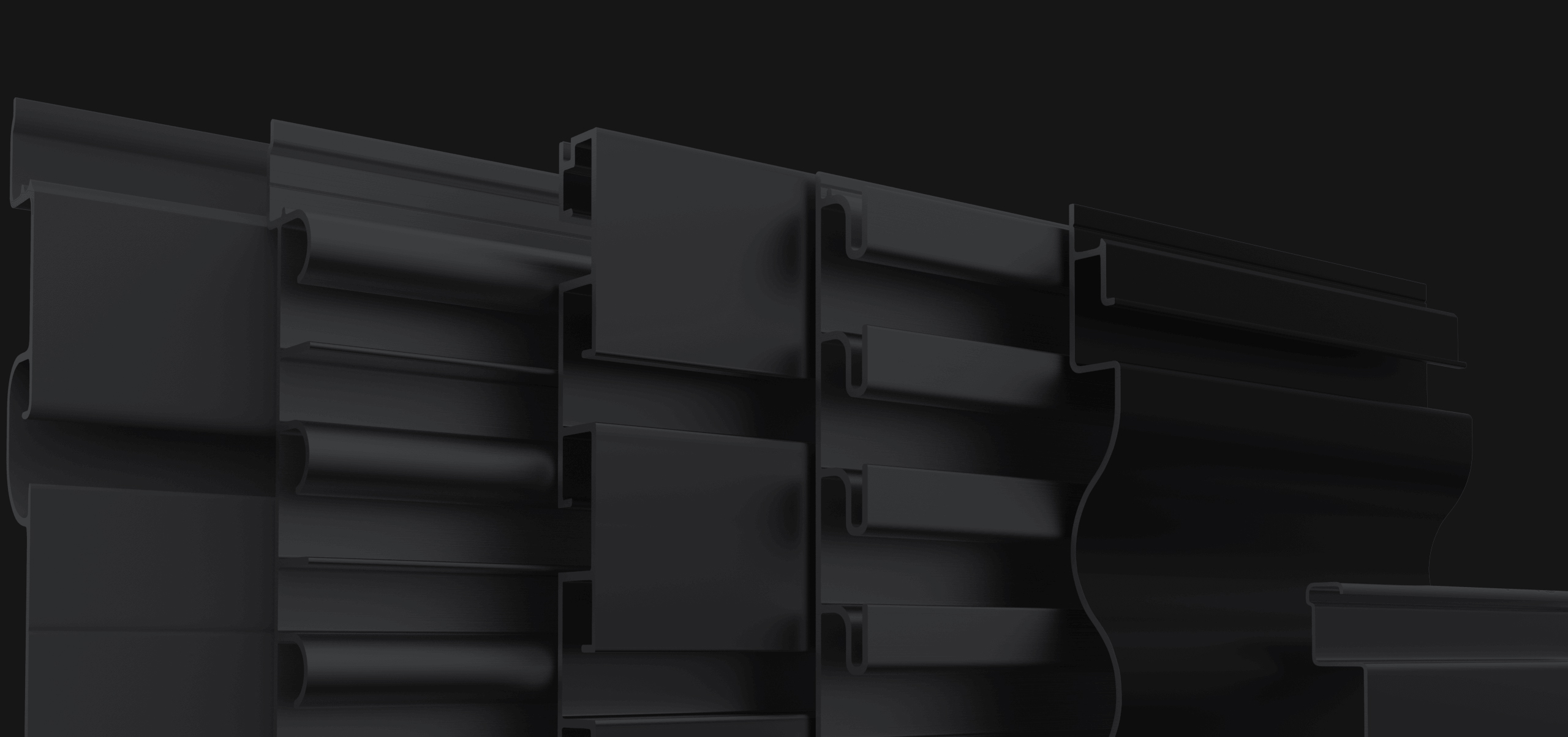
The short answer
Both systems hold over 50 lbs per linear foot. Both meet applicable fire codes. Both are formed and welded metal with a concealed fastener rather than routed board with an aluminum insert. On the two things buyers usually ask about first, they are a tie.
Specify steel when you want the widest colour range, the merchandise is heavy and bulky, and the wall is permanent. Eleven standard finishes, 3″ on center, 32 sq ft interlocking sections.
Specify aluminum when you need slat spacing tighter than 3″, the project is chasing LEED credit, the surface has to wipe clean, or you want a seamless 8′ run with nothing visible on the face.
Side by side
| Attribute | Steel | Aluminum |
|---|---|---|
| Slat spacing | 3″ on center | 1″, 1⅜″, 1½″, 2″, 3″ |
| Weight capacity | Over 50 lbs / linear ft | Over 50 lbs / linear ft |
| Construction | Heavy-gauge steel, formed and welded | Aluminum, 50%+ recycled content |
| Section | 32 sq ft — 8′×4′ or 4′×8′ | 96″ (8′), seamless in hidden fastener |
| Styles | Interlocking, concealed fastener | Flat Back, Hidden Fastener, Double Sided |
| Standard finishes | 11 | 4, plus powder-coat colours |
| Trims | 7 conditions incl. 45° corners | J Cap top and bottom |
| Fire code | Meets applicable codes | Meets applicable codes |
| LEED | — | Certified, 50%+ recycled |
| Cleaning | Powder-coated steel | Wipes down; resists dust and formaldehyde |
| Double-sided | — | Yes, at 2″ O.C. |
| Gondola retrofit | — | Yes — NuPanel uses 1″ aluminum |
Why load capacity is a tie, and what that tells you
People expect steel to beat aluminum on capacity. It does not here, and the reason is worth understanding because it also explains why both beat the MDF systems they compete with.
Conventional slatwall is routed MDF with an aluminum insert dropped into the groove. The insert carries the hook, the board carries the insert, and the failure mode is the board — the slat elongates and eventually the insert pulls. The rated capacity is really a statement about particle board.
Neither Megawall system has a board. Both are formed metal where the slat profile is the structure, so both land past 50 lbs per linear foot as an ordinary working figure. Once capacity is off the table, the decision moves to the things that actually differ.
Where they genuinely differ
Slat spacing
This is the biggest real difference. Steel is made at 3″ on center. Aluminum runs 1″, 1⅜″, 1½″, 2″ and 3″. If your planogram wants a hook at a height that is not a multiple of 3″, aluminum is the answer and steel is not.
Finish range
Steel wins clearly: eleven standard finishes from Dove Gray and Platinum through to Candy Apple Red and Galvanized, against four on aluminum. Custom powder-coat colours are available on both, and both are finished in our own plant.
Certification
Aluminum is LEED certified and made from 50%+ recycled content. Steel is not certified. On a buildout chasing LEED, that single line often decides the specification before anything else is discussed.
Trims
Steel has the richer trim range — top, bottom, side, and inside and outside corners at both 90° and 45°. Aluminum uses J caps at top and bottom. On a wall that follows real architecture rather than a rectangle, that matters more than people expect.
When each one is the wrong choice
Steel is wrong when you need slat spacing under 3″, when the project needs LEED credit, when you are retrofitting gondolas (that is NuPanel, which is aluminum), or when the environment is humid, refrigerated or cleaned daily.
Aluminum is wrong when you need a finish outside the four standard colours and cannot justify a custom powder coat, or when the wall has 45° corners and returns that want the fuller steel trim range.
If you are still undecided after that, the practical move is to stop reading and describe the floor to us. Weight, ceiling height, whether the wall is permanent, and whether the project is chasing certification will settle it in one conversation.